
What’s behind the GOTS certification: Part III
We're back with the third and final part of our short series on GOTS certification, its criteria, and its impact on us, the consumers. This third part focuses on human rights and worker protection at the various stages of production that result in a beautiful, high-quality fabric.
Again, the following information can be found directly on the GOTS website, available in English and German:
“Human rights and social criteria
Prohibition of Forced Labour
GOTS ensures that workers are not compelled to work under any form of menace, penalty, or intimidation. GOTS 7.0 sets explicit criteria for prohibiting various forms of forced labour, such as servitude, bonded, trafficked, or indentured labour.
Prohibition of Child Labour
In addition, GOTS 7.0 introduces more comprehensive provisions to protect young workers, such as restrictions on night work, on hazardous conditions and on working hours and to ensure access to education or vocational training.
Discrimination, Violence and Harassment
The criteria include a zero-tolerance policy for sexual harassment and gender-based violence and encourage confidential reporting of any form of abuse.
Gender Equality
GOTS 7.0 requires Certified Entities to maintain equal, fair and transparent procedures and practises in recruitment, promotion and remuneration and to ensure equal opportunities for all individuals regardless of gender, gender identity, or sexual orientation. In addition, GOTS 7.0 emphasises the protection of pregnant women of mothers and of their children, prohibits dismissal and career setbacks due to pregnancy or maternity leave and protects employees with family responsibilities from discrimination.
Freedom of Association and the Right to Collective Bargaining
It protects workers from any adverse actions or threats due to their union activities. In regions where these rights are restricted, Certified Entities must provide channels for the reasonable and independent exercise of these rights.
Occupational Health and Safety (OHS)
Certified companies are required to establish an occupational health and safety system, protect vulnerable workers and conduct regular risk assessments. Measures to prevent accidents, injuries and illnesses are mandatory, as is the provision of adequate medical assistance. Compliance with fire safety regulations and the provision of accessible emergency exits are mandatory. Health and safety training must be provided to all workers, including those who work from home.
Remuneration and Living Wage
This commitment is aimed at ensuring that wages are sufficient to meet basic needs and provide some discretionary income, promoting a fair and decent life for workers.
Working Hours
Workers must not regularly work over 8 hours a day or 48 hours per week, excluding overtime. They are entitled to rest breaks and a minimum of 24 consecutive hours of rest every seven days. Overtime must be voluntary, not exceeding 12 hours per week, shall not be regularly demanded and shall not pose a higher risk of occupational hazards.
Migrant Workers
GOTS' Human Rights and Social Criteria are designed to ensure fair treatment and respect for textile workers, while ensuring that the products they create are devoid of harmful chemicals, protecting them from severe health concerns.”
« Businesses, as well as consumers, are faced with making choices every day, and sometimes understanding the long-term implications of these choices seems quite opaque. »
If these rights and protections seem normal to you, and you wonder why a textile quality label is necessary to reflect them, it's simply because standards within the European Union are not universal, and the textile industry is global.
Meeting all the criteria of this label requires more investment from manufacturers, and not all brands have made this choice. At Fil Volant, we are committed to offering you a selection of GOTS-certified fabrics.
Businesses, as well as consumers, are faced with making choices every day, and sometimes understanding the long-term implications of these choices seems quite opaque. The textile industry, in particular, is often criticized for water waste during cultivation and production, for the exploitation of factory workers, and for overconsumption habits where clothes and other items are bought for a season and then quickly discarded and replaced.
People who do patchwork and other crafts know that their projects will stay with them (or with family and friends) for years, even decades. Often, we don't count the hours spent completing a project, but it must add up to hundreds sometimes. Generally, our values are far removed from the trends that push us to do more, faster, to produce more.
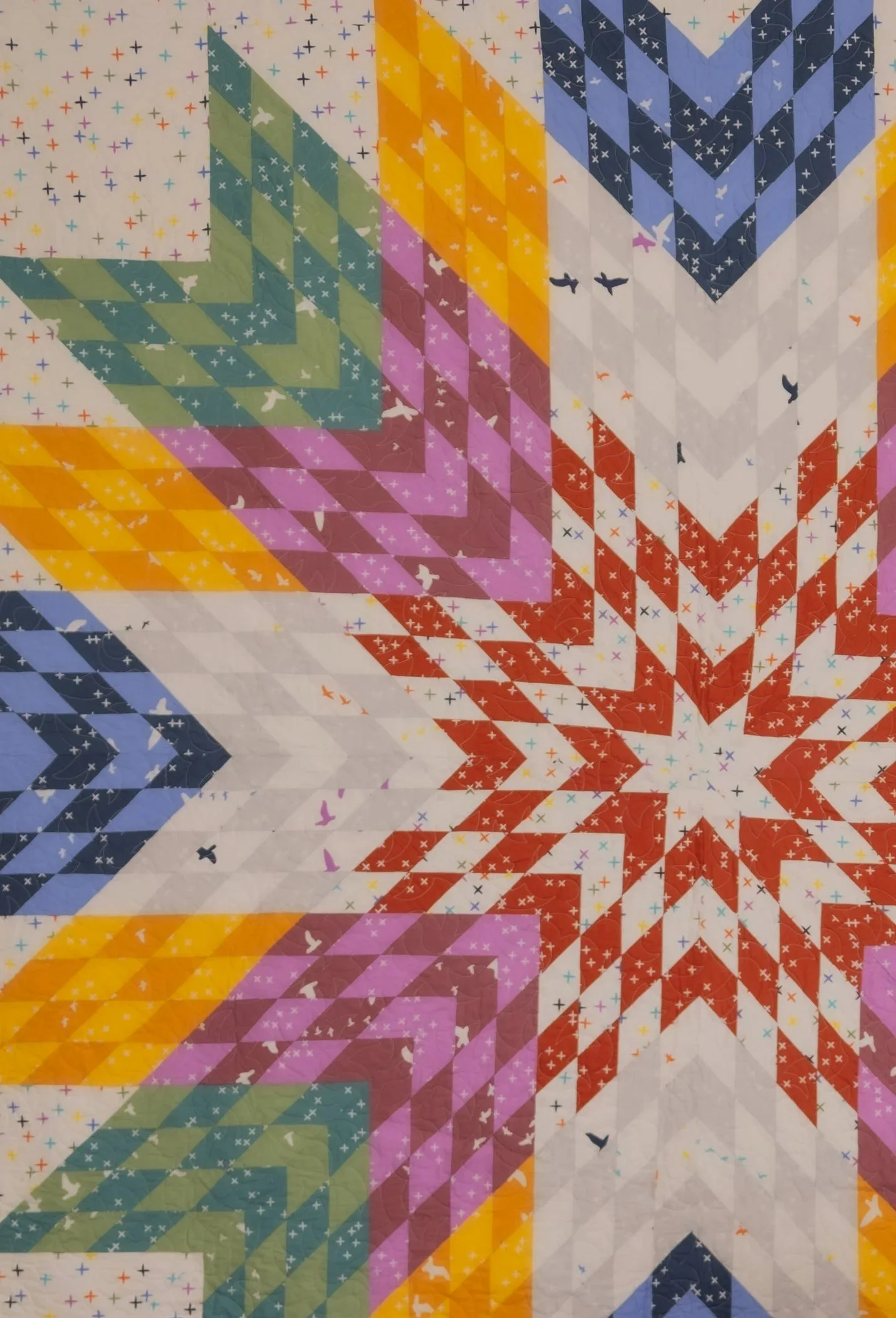
A star quilt made from one of Birch Fabrics collections.
Designing and creating our pieces brings us joy, and we take great pleasure in sharing our creations with loved ones. We spend a lot of time thinking about the pattern, techniques, and colors before starting a project. Sometimes, or even often, we choose our fabrics from what we already have at home. And sometimes, we buy new fabrics to complete a project or to create a special one.
GOTS-certified organic fabrics are more expensive than fabrics without this certification. Organic fabrics are more expensive to produce, to market, and for the consumer at the time of purchase, but they are not more costly in the long run. What is more costly in the long run is environmental degradation and destruction, human exploitation, and overconsumption and waste.
We don't claim to have all the solutions to a complex and evolving global situation.
We have simply decided to offer you the choice.
We have a selection of GOTS-certified organic fabrics, including brands like Cloud9 and Birch Fabrics. If there is enough demand, we can expand this range and offer you even more choices, and we would be delighted to do so!
